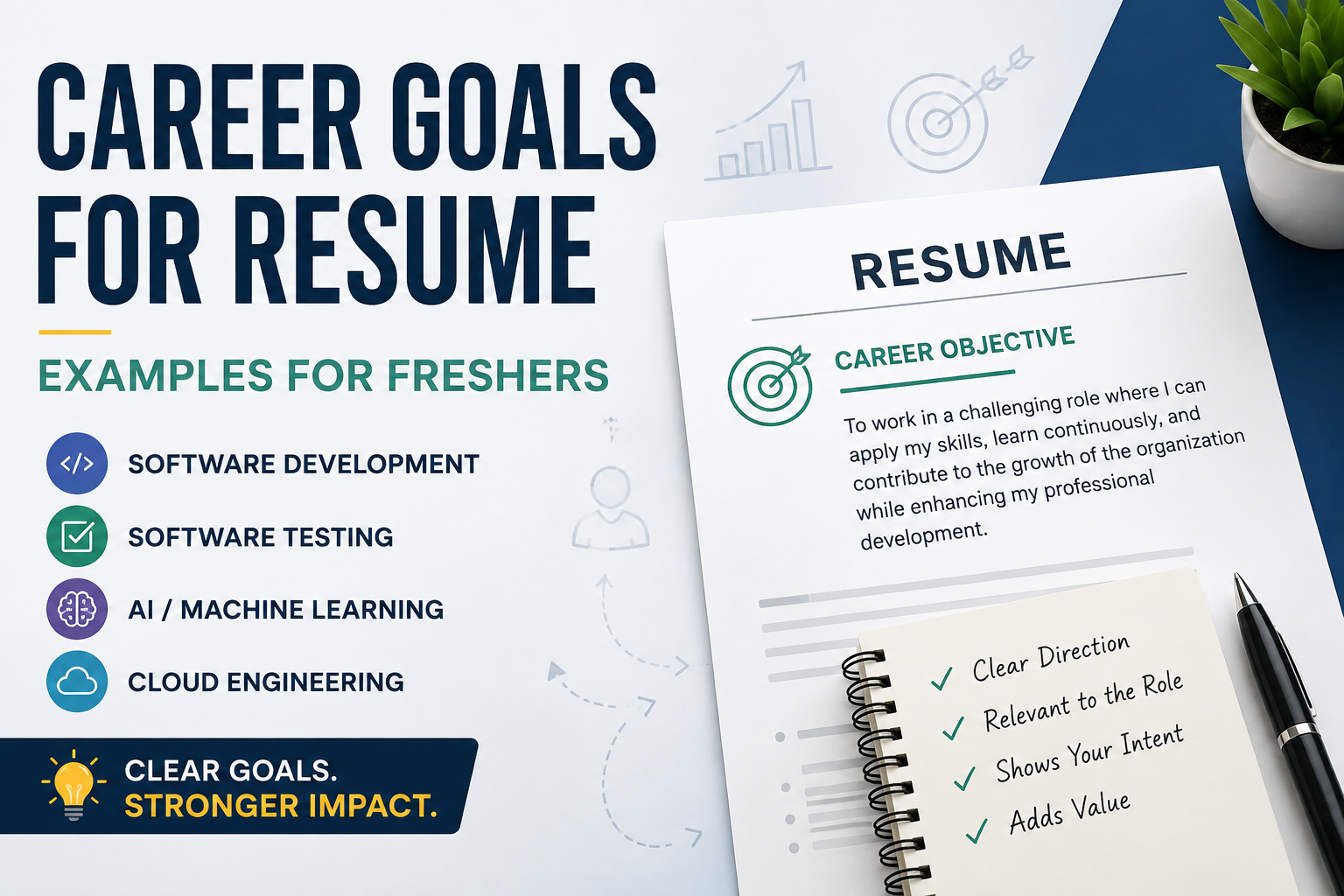
Career goal is a statement that gives recruiter a quick idea of what role you’re looking for and how your skills or experience connect to that role.
Important Note: don’t copy a career objective from a template just because it sounds professional. The examples below are meant to show you how these statements can differ. Your own objective should reflect your interests, background, and the kind of opportunity you are applying for.
Four Simple Career Goal Examples for Freshers
Let’s start with four different directions a fresher might want to pursue.
1. Coding / Software Development
> To begin my career as a software developer where I can use my programming skills to build software applications and continue developing my technical skills.
2. Software Testing
> To begin my career in software testing where I can use my technical and problem-solving skills to help build reliable and high-quality software.
3. AI and Machine Learning
> To begin my career in AI and machine learning where I can use my programming and analytical skills to work on practical AI solutions.
4. Cloud Engineering
> To begin my career in cloud engineering where I can develop my skills in cloud technologies and contribute to reliable and scalable applications.
These four objectives are all fairly simple. None of them is necessarily better than the others.
The important difference is the direction.
A fresher interested in writing software does not need the same career objective as someone who wants to explore software testing. Someone interested in AI does not need to use the same objective as someone who wants to work with cloud technologies.
What Is a Career Goal on a Resume?
A career goal on a resume is simply a short statement about the kind of work or career direction you want to pursue.
For a fresher, it can give the recruiter a quick idea of what kind of role you’re looking for and how your current skills or experience connect to that direction.
You may see this section called a Career Objective, Resume Objective, or simply Objective on different resume formats. For a fresher, the basic idea is much the same.
You are telling the reader:
> “This is the kind of work I want to start with, and this is how my current background connects to it.”
You are not expected to describe your entire career.
Why Can a Career Goal Help a Fresher?
Because it makes your resume easier to understand.
It tells the recruiter what you are looking for
A fresher may have learned several technologies at college and worked on different projects.
The recruiter may not immediately know what kind of role that person actually wants.
A short objective can provide some direction.
For example, if a resume contains Java, SQL, Spring Boot, and a couple of backend projects, an objective mentioning software development or backend development helps put those details into context.
It can connect your background to the job
Your education, projects, skills, and career objective can tell a more consistent story.
Suppose you have built a few React projects and are applying for a frontend developer position. A career objective that points toward frontend development makes the connection easier to see.
This doesn’t mean you should write something simply because it matches a job description.
It should still be a direction you genuinely want to explore.
Your Career Goal Is About Direction, Not a List of Skills
One common mistake is turning the career objective into another skills section.
For example:
> To obtain a challenging position where I can use my knowledge of Java, Python, JavaScript, React, SQL, Git, AWS, Docker and other technologies to contribute to the organization.
The problem isn’t that these skills are bad. The problem is that the statement doesn’t tell the reader much about where you want to go.
A better way to think about it is:
- Your skills tell the recruiter what you can do.
- Your career goal tells them where you want to go.
You can mention one or two relevant skills when they help explain your direction. You don’t need to put every technology you have ever used into the objective.
How Can You Make a Career Goal More Specific?
Software development role
Consider a fresher who knows Java, Spring Boot and SQL and has built a small backend project.
A simple objective might be:
> To begin my career as a software developer where I can use my programming skills to build software applications and continue developing my technical skills.
There is nothing wrong with this. But it could be more specific:
> To begin my career as a backend developer where I can apply my Java and Spring Boot knowledge to building web applications while continuing to develop my software engineering skills.
The second version gives the reader more information.
It tells them:
- The candidate is interested in backend development.
- Java and Spring Boot are relevant to that interest.
- The candidate wants to continue developing their software engineering skills.
The point isn’t that the second version is automatically better for every fresher. It is better if that actually describes the person.
See more about other fields of software company –
Software Testing
A simple objective:
> To begin my career in software testing where I can use my technical and problem-solving skills to help build reliable and high-quality software.
A more specific objective for someone who has explored automation testing could be:
> To begin my career in software testing, with an interest in test automation, where I can apply my programming and problem-solving skills while developing my understanding of software quality.
The second objective makes sense for someone who has actually explored automation testing.
It would make much less sense for someone who has never worked with testing and simply added the phrase because it appeared in a job description.
AI and Machine Learning
A simple objective:
> To begin my career in AI and machine learning where I can use my programming and analytical skills to work on practical AI solutions.
A more specific version could be:
> To begin my career in AI and machine learning where I can apply my Python and machine-learning knowledge to practical projects while continuing to develop my skills in building AI applications.
Again, the candidate should be able to support this statement with something from their background, such as coursework, projects, experimentation, or other genuine experience.
Cloud Engineering
A simple objective:
> To begin my career in cloud engineering where I can develop my skills in cloud technologies and contribute to reliable and scalable applications.
A more specific version could be:
> To begin my career in cloud engineering where I can apply my understanding of AWS and Linux while developing practical experience in deploying and supporting cloud-based applications.
The objective becomes more useful because it gives some idea of the candidate’s current direction without trying to list everything they know.
What Should You Think About Before Writing Your Career Goal?
Instead of searching for a sentence to copy, spend a few minutes answering some simple questions.
What kind of work interests me?
- Do you enjoy writing code?
- Finding bugs?
- Working with data?
- Building AI applications?
- Working with cloud infrastructure?
You don’t have to know your permanent career path. You just need to identify the direction you are currently interested in exploring.
What do I already know?
Think about –
- technologies
- coursework
- projects
- internships
- or other experience that support that direction.
You don’t need to mention all of them in the objective.
Which projects support this direction?
Your projects can help you decide whether your career goal actually makes sense.
If you say you want to work in AI but have spent time building and experimenting with AI projects, you have something concrete behind that statement.
What kind of role am I applying for?
Read the job description and understand what the actual work involves.
If the role genuinely interests you, think about how it fits into the direction you want to explore.
What would I like to learn next?
A fresher’s career goal can include some room for growth.
You don’t have to present yourself as an expert. You can show that you want to build on what you already know.
What NOT to write in career objective
Don’t Try to Sound More Impressive Than You Are
A career objective does not become better just because it contains complicated words.
For example:
> Seeking a challenging position in a dynamic and growth-oriented organization where I can leverage my technical competencies and utilize my potential for the mutual growth of the organization and myself. – This sounds very artificial. Feels copied from template.
It sounds formal, but what does it actually tell the interviewer about the person? Very little.
This type of objective is also common enough that an interviewer may suspect it was copied from a template.
A simpler sentence that actually says what the candidate wants is usually more useful.
Don’t Copy Someone Else’s Career Goal
For example, don’t write an AI/ML objective because it sounds more impressive if you actually want to work in software testing.
Don’t write a cloud engineering objective because the job posting contains the word “cloud” if you have no interest in that kind of work.
And don’t leave the same objective on your resume for years without thinking about whether it still describes you.
Your career goal is supposed to evolve.
As you learn more and gain experience, you may become more specific about what you want to do.
That’s a good thing.
What an Interviewer May Learn From Your Career Goal
There is another reason this small section can be useful: interviewers do read it.
It can be useful when deciding what to ask you during an interview.
A career objective can give an interviewer a general idea of where you want your career to go.
For example, imagine a fresher applies for an social media position, but their resume says their goal is to become a software developer.
That doesn’t automatically mean the candidate should be rejected.
But it does raise a reasonable question:
> Interviewer: Why are you applying for this role?
Maybe.. the candidate is genuinely interested in the editing work.
Maybe.. they are looking for any job they can get.
Maybe.. they want to enter the company and eventually move into technology.
Those are very different situations.
A career objective can sometimes help bring this difference to light.
It can also work in the candidate’s favor.
If someone’s current application doesn’t perfectly match their long-term interest, an interviewer may discover that the company has another team or future opportunity that fits the candidate better.
So the objective isn’t only about convincing the interviewer that you are perfect for the job.
It can also help start a useful conversation about where you want to go.
Be Ready to Talk About Your Career Goal in the Interview
There is one simple rule to remember:
Don’t put something on your resume that you cannot explain in an interview.
If your objective says you want to work in AI, the interviewer may ask:
- Why are you interested in AI?
- What have you done in this area?
- What did you learn from your projects?
- Why do you want an AI role rather than a general software development role?
You don’t need years of experience to answer these questions.
You should, however, have a genuine reason for putting AI in your career objective.
The same applies to testing, cloud, software development, or any other direction.
A Few More Career Goal Examples for Freshers
Here are a few examples showing how the direction can change.
Software Development
> To begin my career as a software developer where I can apply my programming skills to build useful software and strengthen my software engineering abilities.
Backend Development
> To begin my career as a backend developer where I can apply my Java and Spring Boot knowledge to building reliable applications.
Software Testing
> To begin my career in software testing where I can apply my technical and problem-solving skills to improving software quality and reliability.
Test Automation
> To begin my career in software testing with an interest in automation, where I can combine my programming skills with an understanding of software quality.
AI / Machine Learning
> To begin my career in AI and machine learning where I can apply my programming and analytical skills to practical AI projects.
Cloud
> To begin my career in cloud engineering where I can build practical experience with cloud technologies and contribute to reliable applications.
Notice that these aren’t simply different ways of saying the same thing.
They point toward different kinds of work.
And that’s exactly what your career objective should do.
What About Experienced Professionals?
Career objectives become a little different once you have several years of experience. At that point, your resume can say more about the career path you have already taken and the direction you want to move toward next.
We’ll cover career goals and resume objectives for experienced professionals separately.
Final Takeaway
- If you’re a fresher, don’t spend hours looking for the perfect sentence to paste into your resume.
- Think about the direction you genuinely want to explore.
- Then look at your skills, projects, education, and the opportunity you’re applying for.
- Use those to write a short career goal that connects the pieces.
- It doesn’t need to sound impressive.
It needs to sound like you, point in a direction you actually want to pursue, and make sense for the opportunity you’re applying for.
Frequently Asked Questions
A career objective is not mandatory, but it can make a fresher's resume more focused and professional. It can help an interviewer understand what kind of role the candidate is interested in and whether that direction fits the opportunity.
You can mention one or two relevant skills if they help explain your career direction, but your career objective should not become a list of technologies.
No. You do not need to. See the best answers for strengths and answers for weakness to understand how to answer them.
Some parts in your self introduction overlap. But career objective is written in resume and introduction is verbal. See How to introduce yourself as fresher to understand the difference.
They may. An interviewer might ask about your career objective if they want to understand why you applied for the role, what kind of work interests you, or whether your career direction fits the position.
Your career goal should be relevant to the job, but you should not simply copy phrases from the job description.
Yes. Your career direction can change as you learn new skills, work on projects, and gain experience.