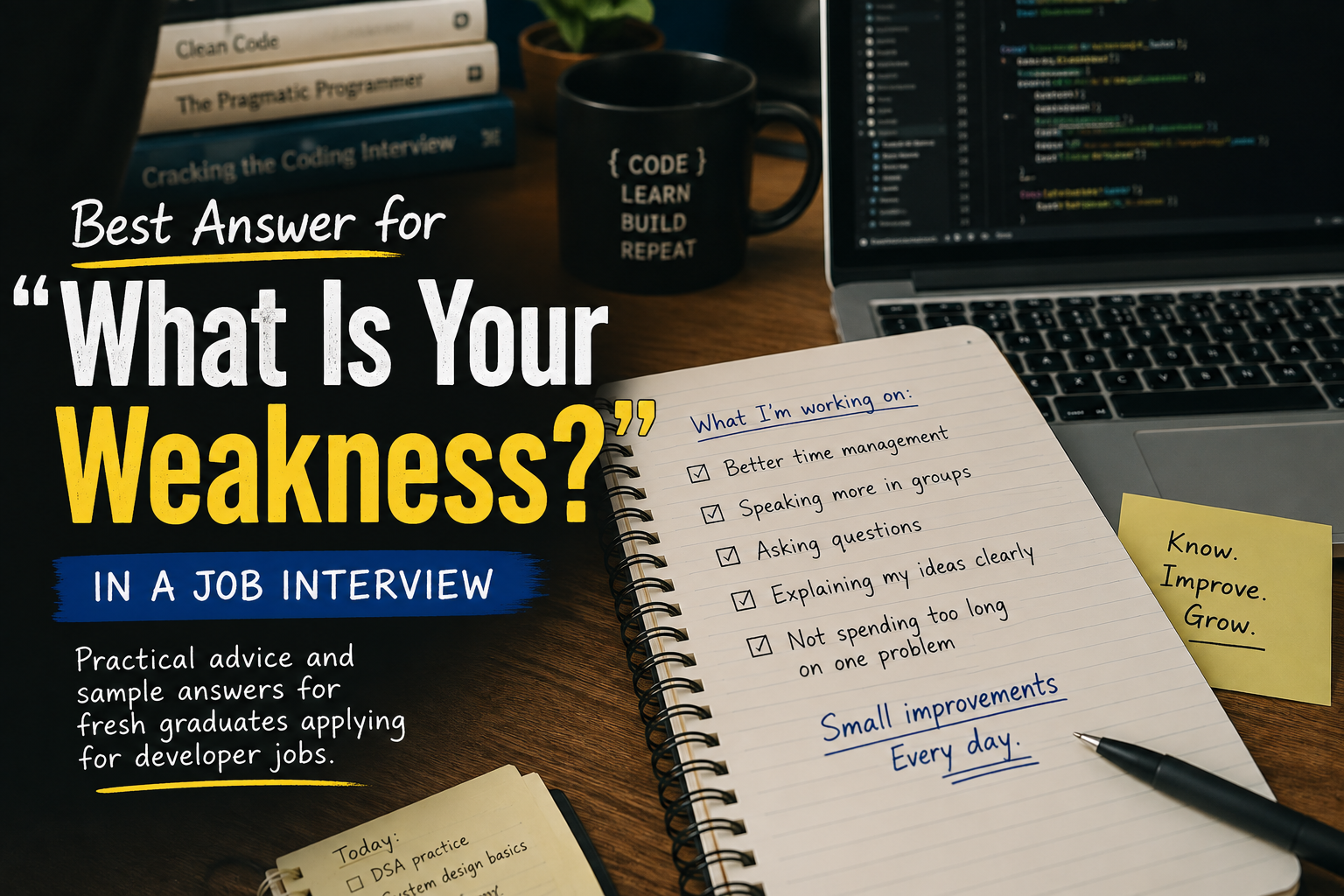
“What is your weakness?”
It is one of those interview questions that can make a fresher pause for a few seconds. The problem is usually not that candidates have no weaknesses. It is that they are unsure which weakness is safe to talk about.
For a fresher applying for a software developer role, the better approach is to talk about a real area that still needs improvement, while showing that they understand it and are doing something about it. Look at some below..
Why do interviewers ask about weaknesses?
The interviewer already knows that a fresher will not be perfect. A graduate applying for their first developer job is not expected to have years of professional experience or know everything about software development.
So the question is usually not about finding something wrong with the candidate. It is more about understanding how the candidate looks at themselves. Also look at the opposite – “What is your Strength?” and they both work similar way to understand the candidate.
This is what interviewer is thinking about candidate –
- Can they recognize something they need to improve?
- Can they talk about it honestly?
- Do they take responsibility for it?
- And, most importantly, are they doing anything to get better?
Imagine two candidates who both struggle with presentations.
One says:
Candidate: “I don’t have any weaknesses. I am good at everything I do.” – This is wrong.
Another says:
Candidate: “I get nervous when I have to explain something in front of a large group. I noticed this during my final-year project presentation, so I’ve been trying to take more opportunities to present and explain my work.” – This tells interviewer that the candidate is self-aware of improvements to make.
The second answer gives the interviewer something useful to understand about the candidate. That is what this question is really about.
What is the interviewer actually trying to understand?
There are a few things an interviewer can learn from this answer.
- Self-awareness: Does the candidate understand their own strengths and areas for improvement?
- Honesty: Are they willing to admit that there are things they still need to work on?
- Attitude toward improvement: Do they simply identify a problem, or are they actually trying to improve it?
- Maturity: Can they discuss something uncomfortable without becoming defensive?
For a fresher, this can be more important than having a particularly clever answer.
A candidate who says,
Candidate: “I don’t know everything yet, but I know what I need to improve and I’m working on it” – Mature and positive.
This can make a much better impression than someone trying to give a perfectly safe answer.
How should a fresher choose a weakness?
The easiest way is to think about situations from college, projects, internships, or technical learning. Look for something that has actually happened to you in real life –
- Maybe you spent too much time trying to solve a programming problem on your own before asking for help.
- Maybe you get nervous when presenting.
- Maybe you struggle to manage your time when several assignments have the same deadline.
- Maybe you are comfortable writing code but find it difficult to explain your solution clearly.
These can all work.
There are two important conditions. First, the weakness should be genuine. Second, it should not make the interviewer seriously question your ability to do the job.
For example, saying
“I don’t enjoy programming” – This is obviously a poor choice for a software developer position.
But saying
“I sometimes spend too long trying to solve a problem myself before asking for help” – You identified improvement area.
This can be a useful answer if that is genuinely true.
Good weakness examples for a fresher
There is no fixed list of weaknesses that everyone should use. This is not something you should memorize obviously. The following are examples of areas that may be relevant to a fresher, along with the kind of answer they could give. Treat them as guidelines only.
1. Spending too much time on a problem
This is common when someone is learning programming. A candidate may become determined to solve a bug or coding problem alone and lose track of time.
A natural answer could be:
Candidate: “Sometimes I spend too much time trying to solve a problem on my own. During my final-year project, I realized that I was stuck on one issue for much longer than necessary. I’m getting better at setting a time limit for myself and asking for help when I know I’m not making progress.”
The important part is not the weakness itself. It is the change in approach.
2. Being nervous during presentations
A fresher may be comfortable working on code but less comfortable explaining it in front of several people.
For example:
Candidate: “I get a little nervous when I have to present in front of a group. I noticed this during college presentations. I’ve been working on it by taking more chances to explain my project and practice before presentations.” – Shows you are working towards improvement.
This is believable, especially for someone entering their first professional environment.
3. Hesitating to ask questions
Some freshers worry that asking questions will make them look inexperienced. In reality, refusing to ask questions can sometimes create bigger problems. I write this with personal experience.
A candidate could say:
Candidate: “Earlier, I used to hesitate before asking questions because I thought I should figure everything out myself. During my project work, I realized that sometimes asking a clear question early saves a lot of time. I’m trying to get better at doing that.” – This also shows that the candidate has learned something from experience.
4. Communication
Communication can be a genuine weakness, but it needs to be explained carefully.
Simply saying
“My communication is bad” – Wrong way to say in interview.
is not very useful.
Instead, describe the specific situation.
For example:
Candidate: “I am comfortable discussing technical things one-on-one, but I sometimes find it difficult to explain them clearly to a larger group. I’m trying to improve by watching discussion techniques in youtube.” – Simple improvement plan is better than NO plan.
That gives the interviewer a much clearer picture.
5. Time management
College can sometimes allow students to postpone work until a deadline gets close. If that has happened, it can be discussed honestly.
Candidate: “Earlier, I wasn’t very good at estimating how long a project task would take, so I sometimes ended up doing too much work close to the deadline. I’ve started breaking larger tasks into smaller ones and setting earlier deadlines for myself.”
The answer works because there is a specific change in behavior.
6. Learning too many technologies at once
This can happen to freshers who are excited about software development. A candidate may start learning React, Node.js, Python, GenAI, cloud platforms and several other technologies without spending enough time becoming comfortable with any one of them.
An answer might be:
Candidate: “I sometimes get distracted by new technologies because there is always something interesting to learn. I’ve started focusing on the technology I need for the current project first instead of trying to learn everything at once.” – Safe and promising improvement.
That is much more useful than simply saying, “I am too curious.”
7. Difficulty in unfamiliar situations
Starting an internship or joining a new team can feel uncomfortable.
A candidate could say:
Candidate: “I can take some time to become comfortable in a completely new environment. During my internship, I noticed that I was quieter during the first few days. Once I understood the team and the work, I became much more comfortable.” – Shows you are a team player.
Again, the answer acknowledges the weakness without making it sound like a permanent problem.
The important part: explain what you are doing about it
A weakness without any attempt to improve it is usually not a very strong answer.
Compare these:
Candidate: “I am not good at time management.” – Don’t decrease your value.
and:
Candidate: “I sometimes underestimate how long a task will take. I’ve started breaking tasks into smaller pieces and giving myself an earlier deadline.” – Increase value by improvement plan.
The second answer tells the interviewer that the candidate has already started dealing with the problem.
The improvement does not need to be dramatic.
It could be something as simple as:
- Practicing presentations
- Using a task list
- Setting time limits for difficult problems
- Asking for help earlier
- Taking notes when learning something new
- Breaking large tasks into smaller ones
- Practicing explanations with friends
- Taking more responsibility during group projects
The improvement should simply be something the candidate actually does.
What if you genuinely don’t know your weakness?
Think about feedback received from teachers, project teammates, internship mentors, or friends. Also think about situations that repeatedly cause difficulty.
Try answering these questions –
- Do you often start tasks late?
- Do you avoid speaking in groups?
- Do you spend too long on small details?
- Do you hesitate to ask for help?
- Do you find it difficult to explain technical concepts?
- Do you get nervous when meeting new people?
- Do you take on too many things at once?
Sometimes a weakness becomes easier to identify when you look at your behavior rather than trying to find the right word for it.
A candidate can also say:
Candidate: “I haven’t thought about it very deeply before, but one thing I’ve noticed recently is that I sometimes spend too much time trying to solve a problem myself before asking for help.” – This is satisfactory answer too.
That is much better than pretending to have a perfectly prepared answer.
What if the interviewer asks for another weakness?
This can happen. The candidate should not panic and start listing every problem they have. Think of another genuine area that is different from the first one.
Think like this – if the first answer was about spending too much time on technical problems, the second could be about presentations or communication.
The same basic approach still applies:
What is the weakness? → Where have you noticed it? → What are you doing about it?
The interviewer is not expecting a confession of every personal flaw.
What should you avoid saying?
The most common mistake is choosing an answer simply because it sounds good.
“I am a perfectionist” is a classic example.
It can work if perfectionism is genuinely causing a problem and the candidate can explain it. But saying it just because it sounds like a positive weakness often feels rehearsed.
Also avoid weaknesses that directly undermine the job. For a software developer role, saying that you dislike coding, don’t like learning new things, or cannot work with other people creates an obvious concern.
Avoid turning the answer into a list of weaknesses too. The question asks for a weakness, not a complete self-assessment.
And don’t spend several minutes explaining it. A short, honest answer with a real example is usually stronger than a long explanation.
A simple formula for building your answer
A fresher can use this simple structure:
Weakness → Example → Improvement
Start by naming the weakness. Then briefly explain where you noticed it. Finally, explain what you are doing to improve.
Check this statement:
Candidate: “I sometimes spend too long trying to solve a problem myself. I noticed this during my final-year project when I got stuck on a bug for quite a while. Now I give myself some time to investigate it, and if I’m still not making progress, I ask someone for help.”
That is enough. There is no need to memorize those exact words. The candidate should understand the idea and explain it naturally in their own way.
The best weakness is not the most impressive one
Freshers sometimes spend too much time trying to find the “right” weakness.
There isn’t one.
The best answer is not the weakness that sounds cleverest or safest. It is an honest weakness that the candidate understands and is working to improve. A good answer tells the interviewer:
“I know where I need to improve, I have noticed it in real situations, and I am doing something about it.”
For a fresher, that kind of self-awareness is far more useful than pretending to have no weaknesses.