What exactly should you write for Internship Objective?
A good internship objective should quickly tell the recruiter what kind of internship you are looking for and what you hope to learn or gain from the opportunity.
What Is an Internship Objective?
An internship objective is a short statement near the top of your resume that explains the type of internship you are seeking and, usually, what you want to gain from it.
For a student or fresher, it can provide useful context when the rest of the resume contains mostly education, coursework, projects, and skills.
A good objective is usually one or two sentences, around 30–50 words.
For example:
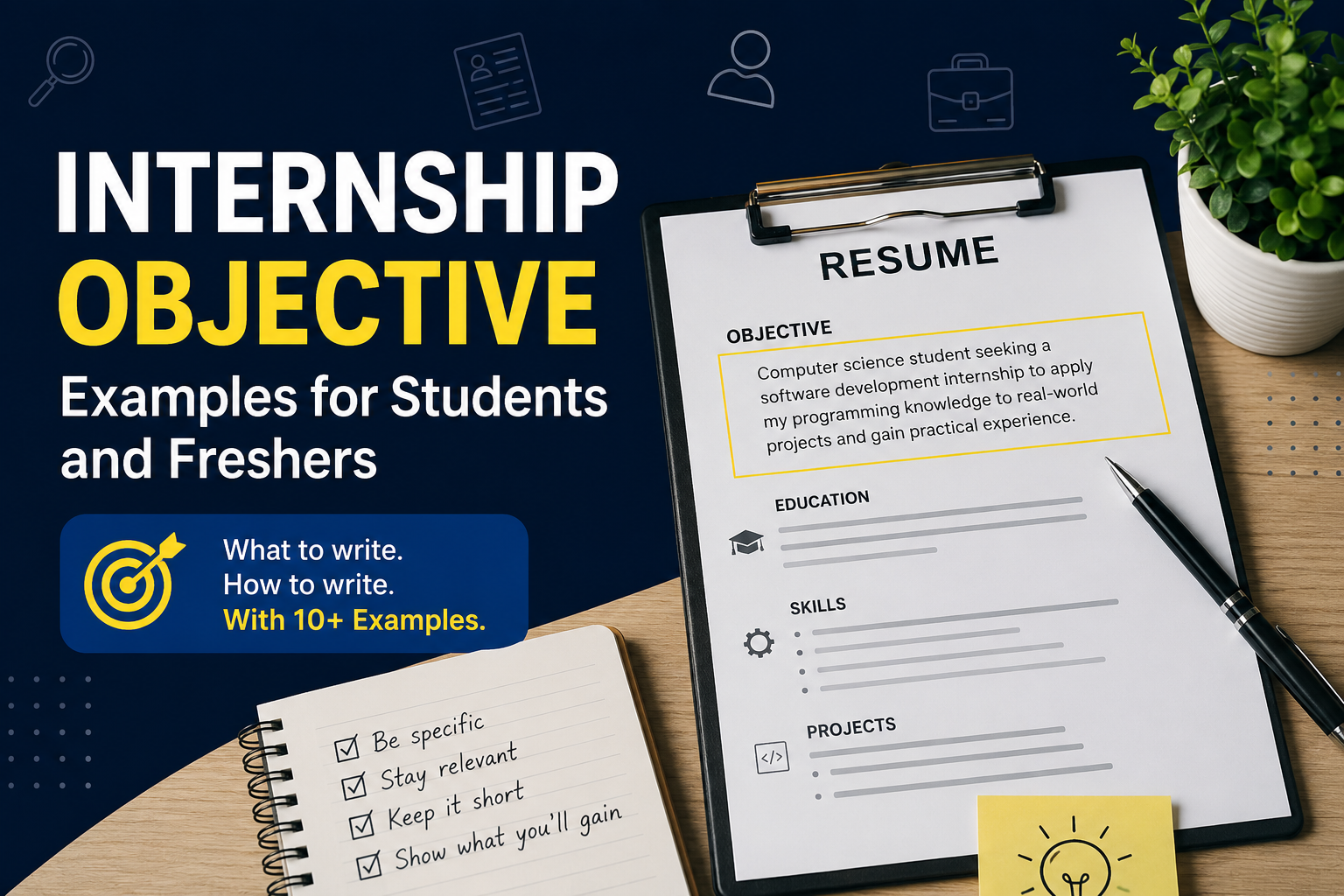
> Computer science student seeking a software development internship to apply my programming knowledge to real-world projects and gain practical experience working with software development teams.
The objective doesn’t claim that the student is already an experienced software developer. It simply explains what opportunity they are looking for and what they want to gain from it.
Why Is an Internship Objective Useful?
Recruiters may look at many resumes for the same internship. A short objective can help them understand your application quickly.
It can:
- Tell the recruiter what type of internship you are looking for.
- Give context to your education, projects, and skills.
- Show that your interests are relevant to the internship.
- Make your resume feel more focused.
The objective isn’t there to convince the recruiter that you are already an expert. It gives them a quick idea of where you are looking to start.
What Should You Include in an Internship Objective?
For most students and freshers, two things are enough:
1. The opportunity you are looking for
Mention the type of internship or area you are interested in.
For example:
- Software development internship
- Web development internship
- AI/ML internship
- Cloud or DevOps internship
- Testing or QA internship
2. What you hope to learn or gain
Think about what you want from the internship.
You might want to:
- Gain hands-on experience
- Work on real-world projects
- Apply what you have learned in college
- Understand how software is developed in a professional environment
- Learn how development teams work
You don’t have to know exactly where your career will take you. The objective is about the next opportunity, not your entire future. Career goals for freshers comes when you are looking for a full time job.
How to Write an Internship Objective
A simple way to write one is:
[Who you are] + [internship you are seeking] + [what you hope to learn or gain]
For example:
> Computer science student seeking a web development internship to apply my knowledge of HTML, CSS, and JavaScript while gaining practical experience building websites and web applications.
You can adjust the wording depending on the internship. You don’t need to follow this formula word-for-word. It is simply a way to make sure your objective answers the basic questions a recruiter may have.
Should You Customize Your Internship Objective?
Yes, but you don’t need to completely rewrite it for every application. Keep the basic structure and change the parts that are relevant to the particular internship.
Suppose you have a general objective like:
> Computer science student seeking an internship to gain practical experience in technology and apply what I have learned through my coursework and projects. – This is generic.
If you are applying for a software development internship, you could make it more specific:
> Computer science student seeking a software development internship to apply my programming knowledge and gain practical experience working on real-world software projects. – Provides more details to interviewer.
The second version gives the recruiter a clearer idea of what you are applying for.
Internship Objective Examples
The following examples are intentionally written at a fresher level. Use them as an example to build your own.
1. Software Development Internship
Situation: You are a computer science student who wants to start with software development using python language.
> Computer science student seeking a software development internship to apply my python programming knowledge to real-world projects and gain practical experience working in a professional development environment.
Why it works: It clearly identifies the opportunity and focuses on gaining practical experience without claiming professional-level expertise.
2. Software Development Student With a Project
Situation: You have built a few college or personal programming projects and want to highlight it.
> Computer science student seeking a software development internship to build on my programming and project experience while learning how software is designed, developed, and maintained in a professional environment.
Why it works: The objective acknowledges existing experience without turning the statement into a list of technologies.
3. Web Development Internship
Situation: You have learned basic web technologies and want practical experience.
> Computer science student looking for a web development internship to apply my knowledge of HTML, CSS, and JavaScript and gain hands-on experience developing websites and web applications.
Why it works: It mentions relevant skills because they directly support the type of internship being sought.
4. AI/ML Internship
Situation: You have studied basic AI or machine learning and want to explore the field further.
> Computer science student seeking an AI/ML internship to apply my understanding of machine learning concepts and gain practical experience working with real-world data and AI projects.
Why it works: It shows interest in AI/ML without suggesting that the student is already an experienced machine learning engineer.
5. Cloud or DevOps Internship
Situation: You have learned some cloud or DevOps concepts through coursework or personal learning.
> Computer science student seeking a cloud or DevOps internship to apply my understanding of cloud technologies and gain practical experience with the tools and processes used to build and manage software systems.
Why it works: It keeps the objective broad enough for a student who is still learning about the field.
6. Testing / QA Internship
Situation: You are interested in software testing but don’t have professional testing experience.
> Computer science student looking for a software testing internship to learn how applications are tested in a professional environment and gain hands-on experience with software quality and testing practices.
Why it works: It focuses on learning and practical exposure rather than claiming expertise in QA.
7. Student Who Is Still Exploring
Situation: You know you want a technology internship but haven’t decided exactly which specialization you want to pursue.
> Computer science student seeking a technology internship to apply my academic knowledge, gain practical experience, and explore different areas of software development and technology in a professional environment.
Why it works: You don’t have to pretend that you have already chosen a lifelong career path. The objective honestly reflects that you are exploring.
8. Student With Limited Experience
Situation: You don’t have major projects or previous internships yet.
> College student seeking an internship opportunity to apply what I have learned through my coursework, develop practical skills, and gain experience working in a professional environment.
Why it works: You don’t need to invent experience. The objective focuses on what you are looking for and what you want to gain.
9. Student Applying for a Specific Role
Situation: The internship description is specific about the work involved.
Suppose the internship involves developing web applications with JavaScript. Your objective could be:
> Computer science student seeking a web development internship to apply my JavaScript and web development knowledge while gaining hands-on experience building and improving web applications.
Why it works: The objective is tailored to the opportunity without becoming a copy of the job description.
10. Student With Several Interests
Situation: You have explored programming, AI, and web development and aren’t sure which one you want to pursue long term.
> Computer science student seeking a technology internship where I can apply my programming and project experience, gain hands-on experience, and learn how technology is used to solve real-world problems.
Why it works: It leaves room for exploration while still giving the recruiter a clear idea of what you are looking for.
If a particular internship is clearly focused on one area, however, customize the objective for that role.
What Should You Avoid in an Internship Objective?
A good objective isn’t about using impressive-sounding language. Avoid the common mistakes that make objectives less useful.
Avoid generic statements
Don’t write:
> Seeking a challenging opportunity in a dynamic organization where I can utilize my skills and contribute to organizational growth. – This is not good. This seems copied from a template or AI.
This could describe almost any job or internship. Instead, tell the recruiter what type of opportunity you are actually looking for.
Don’t list every skill you have
Your objective isn’t the place to list Python, Java, React, SQL, AWS, Git, Docker, and every other technology you have encountered.
Those belong in the Skills section of your resume. Mention a skill in the objective only when it is directly relevant to the internship and helps explain your interest.
Don’t claim expertise you don’t have
If you have completed a beginner machine learning course, don’t describe yourself as an “expert in machine learning.”
An internship is an opportunity to learn. You can be honest about being a student while still showing that you have a relevant foundation.
Don’t make it entirely about what the company can give you
Learning is a perfectly reasonable reason to seek an internship. But avoid making the objective sound like:
> Looking for an internship where I can learn everything I need to get a good job. – This feels very artificial.
Connect what you want to learn with the opportunity you are applying for.
Don’t turn it into your entire career plan
You may eventually want to become a software architect, AI engineer, engineering manager, or something else entirely.
You don’t need to explain that in your internship objective. Your internship objective is about the opportunity you are looking for now.
If you are working on your broader career direction, see our guide to career goals for freshers for that topic.
Don’t use exactly the same objective everywhere
You don’t need a completely different objective for every application. But if you are applying for a web development internship, an AI/ML internship, and a testing internship, changing the relevant parts of the objective can make your resume more focused.
Internship Objective vs. Career Objective
These two statements are related, but they serve different purposes.
- An internship objective focuses on the opportunity you are looking for now and what you hope to gain from it.
- A career objective is more concerned with the direction you want your career to take.
As a college student, you may not have a completely defined career direction yet. That’s okay. You can be specific about the internship you want without pretending that you already know exactly what you will be doing ten years from now.
Should You Copy an Internship Objective From the Internet?
It is better to use examples as a starting point rather than copying one exactly. A copied objective may mention skills, technologies, or career interests that don’t match your background. Experienced Interviewer
Instead, take an example and ask:
- What internship am I applying for?
- What do I already know that is relevant?
- What do I want to learn or gain?
- Can I say this honestly?
Then write a short statement using your own situation.
The best internship objective is not necessarily the most impressive-sounding one. It is the one that accurately explains what you are looking for.
Final Takeaway
An internship objective doesn’t need to make you sound like an experienced professional.
You are a student or fresher, and the purpose of an internship is partly to gain experience and discover what kind of work you enjoy.
Keep your objective short. Be honest about what you know. Identify the internship you are looking for and explain what you hope to gain from it.
Most importantly, use the examples as a guide rather than something to copy word-for-word. Your objective should describe your situation, not someone else’s.
Frequently Asked Questions
For most students and freshers, one or two sentences, around 30–50 words, is enough. Give useful information without
It can be useful, particularly when the student has limited professional experience. A short objective can help explain what type of internship they are seeking and give context to the rest of the resume.
Generally internship interviews follow similar pattern like freshers. See frequently asked questions for freshers and how to answer them to understand and prepare.
You can keep the same basic structure, but it is better to make small changes based on the internship. Mention the relevant area and adjust the learning goal when appropriate.
That's normal for a college student. Your internship objective doesn't need to define your entire career. You can focus on the type of opportunity you are currently exploring and what you hope to learn from it.
Only when they are directly relevant to the internship. You don't need to list all your skills. The main purpose of the objective is to explain the opportunity you are seeking and what you hope to gain.