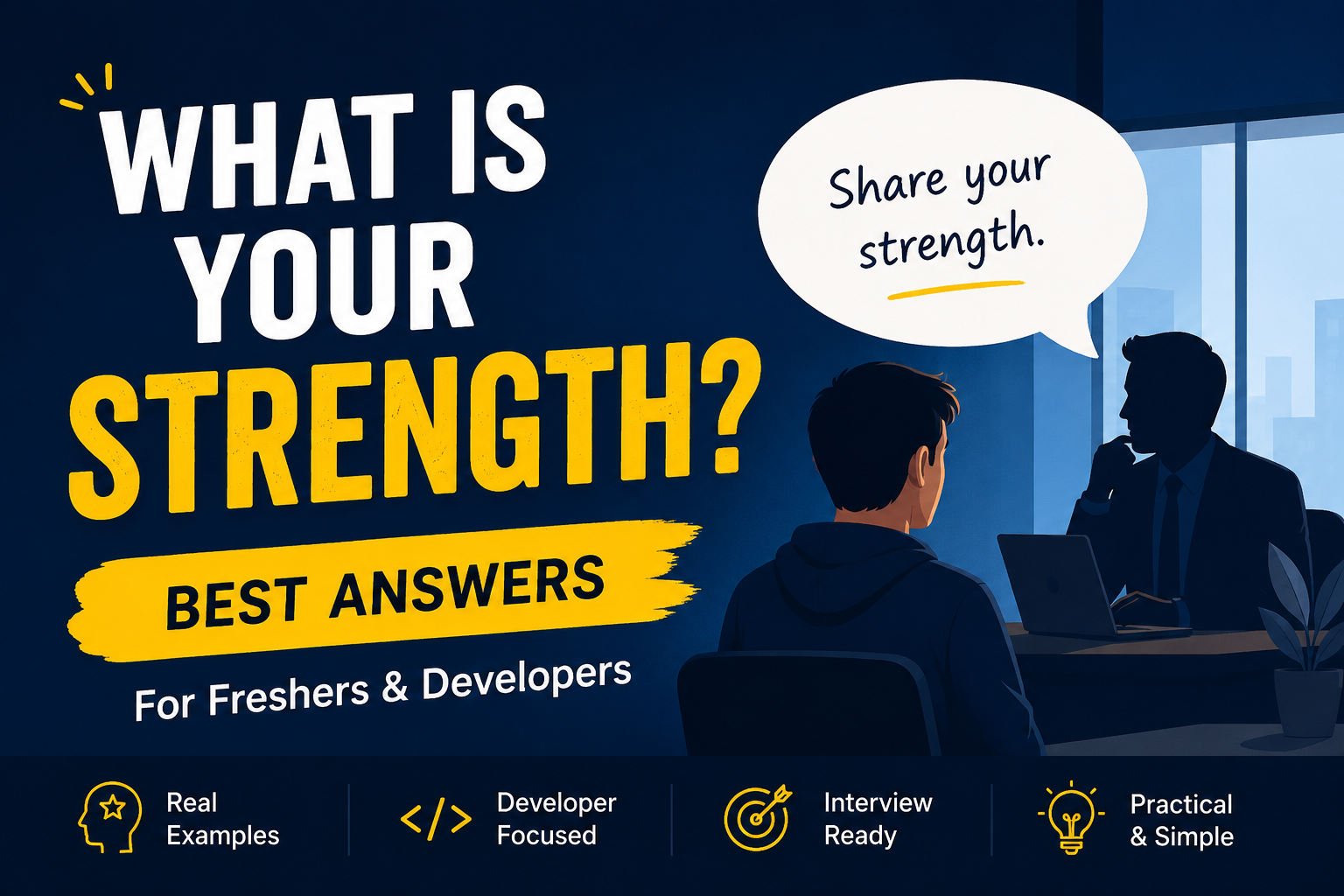
“What is your strength?” sounds like a simple interview question. But when you are a fresher, it can be a little difficult to answer.
You may have several strengths, but which one should you mention? And how do you explain it without sounding like you are simply saying what you think the interviewer wants to hear? For a fresher, a genuine strength supported by a simple example can make a much better answer than a list of impressive-sounding qualities.
What Is the Interviewer Looking For?
When an interviewer asks about your strength, they are usually trying to understand how you approach work and whether you know yourself reasonably well. They are not necessarily looking for the “best” strength.
For example, saying:
Candidate: “My biggest strength is that I am hardworking.” – This is average.
doesn’t tell the interviewer very much.
Compare that with:
Candidate: “One of my strengths is that I don’t give up quickly when I get stuck on a problem. During my final-year project, I had an issue that I couldn’t solve initially, so I broke it into smaller parts and worked through it instead of trying random solutions.” – This demonstrates how you are hardworking.
The second answer gives the interviewer something they can understand. And have followup questions. Here are some good interview questions for later study.
What Can a Fresher Say as a Strength?
You don’t need professional experience to talk about your strengths. Think about your college projects, assignments, internships, group work, or even situations where you had to learn something on your own.
Some strengths that can work well for a software developer interview include:
- Learning quickly
- Problem-solving
- Patience when dealing with difficult problems
- Being organized
- Paying attention to details
- Communicating clearly
- Working well with others
- Taking responsibility
- Being willing to ask questions and learn
- Staying consistent when working toward a goal
The important part is not the strength itself. It is being able to explain it naturally.
Sample Answers for “What Is Your Strength?”
Here are some examples of how a fresher could answer the question.
1. Learning Quickly
Candidate: “I think one of my strengths is that I can learn new things quickly. When I was working on my final-year project, I had to use a technology I hadn’t worked with before. I spent some time learning the basics on youtube and then started using it in the project.” – This informs how you learnt and mode of learning clearly.
This works well if you have examples of learning a new programming language, framework, tool, or technology. Be ready for followup questions by interviewer based on your statement.
2. Problem-Solving
Candidate: “I would say problem-solving is one of my strengths. When something doesn’t work, I usually try to understand why it is happening instead of immediately looking for a solution online. For example, while working on a project, I had a bug that took some time to find. I went through the code step by step and eventually found the issue.” – You showed that you understand and solve issues.
This is particularly relevant for software development roles because problem-solving is a regular part of the job.
3. Patience
Candidate: “One of my strengths is that I’m very patient when working on difficult problems. If I don’t get something right the first time, I usually take a step back and try a different approach rather than getting frustrated and leaving it.”
This can be a good answer if you genuinely behave this way. You don’t need to claim that you are patient in every situation.
4. Attention to Detail
Candidate: “I think I’m reasonably good at noticing small details. When I am coding, I pay attention to coding standards, clean code and organize in folders. Sometimes I’ve caught small errors that I didn’t notice while writing the code.” – This shows you have practical experience in clean code.
5. Communication
“I think communication is one of my strengths. I try to explain things clearly, especially when working with other people. During group projects, I usually made sure everyone understood what we were working on and what needed to be done next.” – Also shows responsibility.
Communication doesn’t mean that you have to be the most talkative person in the room. Being able to explain a problem clearly can be just as valuable.
6. Being Organized
Candidate: “One of my strengths is that I like keeping my work organized. When I have a project with several things to complete, I usually break it into smaller tasks and work through them one at a time. It helps me keep track of what I’ve finished and what still needs attention.”
This is a useful answer if you actually have a habit of planning your work. If not, you can read other strengths. Try not to claim anything which you are not. An honest answer goes a long way.
7. Willingness to Learn
Candidate: “I’d say my willingness to learn is one of my strengths. If I come across something I don’t know, I’m generally comfortable admitting that I don’t know it and then trying to learn it. That’s happened quite a few times while working on college projects.”
For a fresher, this can be particularly relevant because nobody expects you to know everything when you are starting your career. Interviewers look for candidates who are more willing to learn and improve while on the projects.
You Don’t Have to Choose a Perfect Strength
One mistake freshers make is trying to find the most impressive strength possible.
You don’t need to say that you are a “natural leader,” “excellent communicator,” or “highly analytical thinker” just because those sound good. A simple strength can be better if you can actually support it.
Candidate: “I am good at staying focused when I have a task to finish.”
This is perfectly fine.
If the interviewer asks for an example, you should be able to talk about a project, assignment, or other situation where this was true. That is much better than choosing a strength because it sounds impressive and then struggling to explain it.
What If You Don’t Have Work Experience?
That’s completely fine. As a fresher, you can use examples from:
- College projects
- Final-year projects
- Internships
- Coding assignments
- Hackathons
- Group projects
- Learning a new technology
- Solving a difficult problem on your own
The interviewer knows you are a fresher. They are not expecting you to have years of professional experience. What matters is showing them how the strength has appeared in something you have actually done.
Avoid Giving a List of Strengths
You don’t need to say:
Candidate: “My strengths are problem-solving, communication, leadership, teamwork, time management, adaptability and hard work.” – Don’t use everything as strength.
That sounds more like a list copied from a resume than an interview answer. Pick one strength and explain it. If the interviewer wants to know about other strengths, they can always ask.
A Simple Way to Build Your Answer
A useful way to think about your answer is:
Strength → small explanation → real example
Read this example:
Candidate: “One of my strengths is learning new things quickly. I had to learn a technology I hadn’t used before for my final-year project, so I spent some time understanding it and then started using it in the project.” – What? How? Where? Answered all three questions.
- What is the strength?
- How did you show it?
- Where did you use it?
You don’t have to follow these exact words. The idea is simply to give the interviewer a reason to believe that the strength is actually yours. If you are looking how to introduce yourself, here is an article on self intro for fresher. Strength is different than self intro.
What If the Interviewer Asks for Another Strength?
You don’t need to panic if they follow up with:
“What is another strength?”
You can simply choose another genuine and honest quality and briefly explain it.
For example:
Candidate: “Another strength would probably be patience. I don’t mind spending time on a problem when I know there is something I haven’t understood yet.”
Again, there is no need to turn the answer into a long speech. Please NO speeches.
What Should You Avoid Saying?
Try to avoid strengths that are too generic unless you can explain them.
For example:
“I am a hard worker.” – No info about how you are a hard worker.
“I am a perfectionist.” – Did not demonstrate how.
“I am very passionate.” – No example given to understand.
“I always give 100 percent.” – Does not relate to any real example.
These aren’t necessarily bad qualities. The problem is that almost anyone can say them.
If you do choose one, explain what it looks like in something you have actually done.
Also avoid claiming a strength that you cannot demonstrate. If you say that communication is your biggest strength but struggle to explain your own project, the answer may work against you.
The Best Answer Is the One You Can Explain
There isn’t one best answer for “What is your strength?”
A good answer for one fresher may be completely different from another.
The important thing is to choose something that is genuinely true about you, give the interviewer a little context, and be ready with an example if they ask.
You don’t need to impress the interviewer with a complicated answer. You just need to give them a clear reason to believe that the strength you mentioned is actually one of yours.