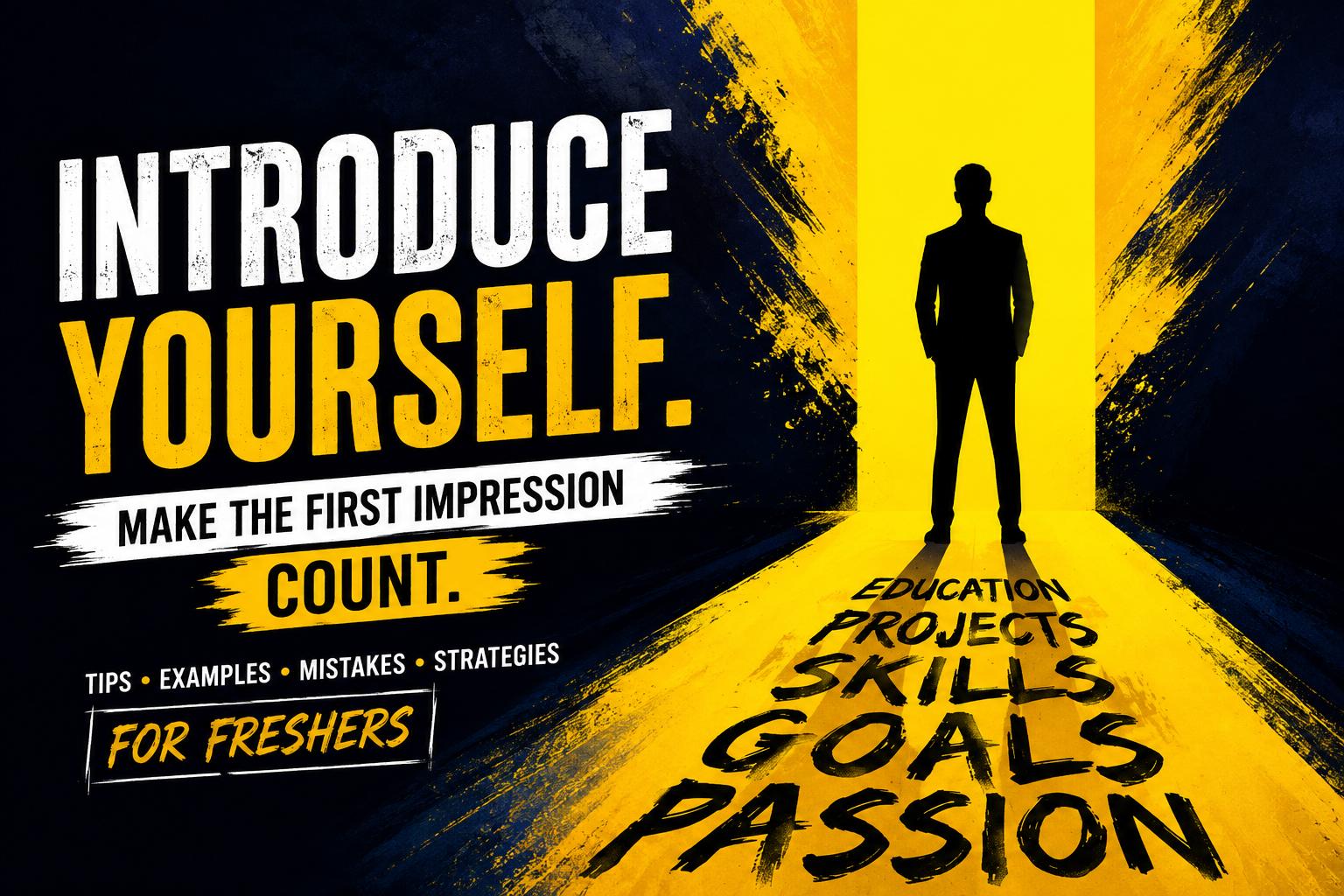
Start with your name and what you have studied. Add any unique projects or experience from your academy. Mention what you are looking forward to do and what you want to learn from the company.
A good self intro is simply [Who you are] + [What you know] + [What do you want to do].
Interviewer: “Tell me about yourself.”
The important thing to remember is that your self-introduction is not a speech. It is the beginning of a conversation with interviewer. Your goal is to give the interviewer a quick idea about your education, your practical experience, and what interests you.
For most interviews, 1–2 minutes is a good range, but don’t treat that as a strict rule. The situation and the interviewer’s response should guide you. This is different than “What is your Strength?” question. They both are different and you can read more there.
What should a fresher include?
A simple structure is:
Education → Projects or practical work → What interested you → What you’re looking for
For example:
Candidate: “Hi, I’m Kiran. I recently completed my B.Tech in Computer Science. During my final year, I worked on a student management application using React and Node.js. I mainly worked on the backend and API integration. I enjoyed the problem-solving part of the project, which made me more interested in backend development. I’m now looking for an opportunity where I can apply what I’ve learned and gain experience working on real-world applications.”
You don’t have to use these exact words. Think of this as a structure rather than a script.
Are you thinking “How to introduce myself “?
Talk about something you have actually done
For a software developer fresher, projects are often the most useful part of the introduction.
Instead of saying:
Candidate: “I know Java, Python, React, Node.js and SQL.” – This is less and incomplete.
give the interviewer some context.
For example:
Candidate: “I used Java and Spring Boot for my final-year project, where I built APIs for a college event management application. I also worked with MySQL for storing the application data.” – This gives good information.
Now the interviewer has something specific to ask about.
They might ask why you chose Spring Boot, how your APIs work, or how you designed the database. That is much better than simply listing technologies.
Your introduction can change depending on the interview
You don’t need one introduction for every situation.
HR or initial screening
Focus more on your background, interests, and what you are looking for.
Candidate: “I’m Rahul, and I recently completed my BCA. During college, I worked on a couple of web development projects and became particularly interested in backend development. I’ve been building small applications using Node.js and working with databases to improve my practical skills. I’m now looking for my first opportunity to work as part of a professional development team.” – This gives HR basic information needed without going into deep technical dive.
Technical interview
You can make the introduction more technical if the situation calls for it.
Candidate: “I’m Sneha, and I recently completed my Computer Science degree. My main interest is backend development. For my final-year project, I built a REST API using Python and Django with PostgreSQL. I worked mainly on the API layer and database operations, and I’ve continued exploring backend development through personal projects.” – This provided good technical information and experience.
The interviewer may immediately start asking about Django, APIs, or PostgreSQL. That’s fine. Follow the conversation instead of trying to finish your prepared introduction.
Campus placement
A campus interview may require a slightly broader introduction because the interviewer may know very little about you.
Candidate: “Good morning. I’m Arjun, currently in my final year of B.Tech in Information Technology. I’ve been interested in software development throughout college, and one of my main projects was a library management system using Java and MySQL. I worked on the application logic and database operations. That project made me more interested in backend development, and I’m looking forward to starting my career in a software development role.”
Pay attention to the interviewer’s response
Suppose you say:
Candidate: “I built an e-commerce application using React and Node.js.”
and the interviewer asks:
Interviewer: “What exactly did you work on?”
That’s where the conversation is going.
Talk about the project.
Don’t think, “I still have three more sentences in my introduction.” Intro is for starting a conversation as I mentioned above. It should NOT be a speech.
Similarly, if the interviewer asks why you chose backend development, answer that question rather than trying to return to your prepared script.
A good interview is a conversation, not a presentation.
Four mistakes freshers should avoid
1. Giving a memorized answer
A perfectly memorized introduction can sound robotic.
Instead of remembering every word, remember the important points:
- Your education
- Your main project
- What you worked on
- What interested you
- What type of role you want
Practice saying these points in different ways.
Record yourself and listen to the recording. Notice which parts sound natural and which parts sound like you’re reading a script.
Keep changing it until it sounds like something you would actually say.
2. Sharing unnecessary personal details
Your introduction doesn’t need to include your entire life story. You do NOT have to mention your family, favorite movies, food, hobbies, or childhood ambitions unless they are relevant or naturally become part of the conversation.
Before including something, ask:
“Does this help the interviewer understand me as a candidate?”
If not, leave it out.
3. Listing skills without examples
Saying:
Candidate: “I know Java, Python, React and SQL.” – This is wrong and incomplete.
doesn’t tell the interviewer how well you actually know them.
Instead, connect skills to something you have done:
Candidate: “I used React for the frontend of my final-year project and Node.js to build the backend APIs.” – This is better. Connects technology + your experience.
Now you can discuss your actual experience. Also, don’t mention technologies just because they sound impressive. If you put something in your introduction, be prepared for the interviewer to ask about it.
4. Speaking for too long
A longer introduction isn’t necessarily a better introduction. If you spend five minutes explaining everything you’ve ever done, the interviewer may lose the opportunity to guide the conversation.
For most situations, 1–2 minutes is enough.
But pay attention to the interviewer. If they interrupt you with a question, that’s not necessarily a problem. They may simply have found something interesting to discuss.
Should you memorize your introduction?
Practice it, but don’t feel that you have to memorize every word.
Ask yourself:
- Does this sound like me?
- Am I speaking too quickly?
- Does anything sound artificial?
- Which parts feel comfortable?
- Which parts feel like I’m reciting something?
Then improve it and try again. You may eventually prefer a few fixed sentences. That’s fine. Someone else may prefer remembering only the key points. That’s fine too.
The goal of practice is to become comfortable enough to have a conversation, not to deliver a perfect speech.
What if you get nervous?
You don’t have to completely eliminate nervousness.
Start with simple sentences that are easy to say.
Candidate: “Hi, I’m Meera. I recently completed my B.Tech in Computer Science…”
Then move naturally into your project:
Candidate: “During my final year, I worked on…”
Once you start talking about something you actually worked on, the conversation often becomes easier. And remember, taking a short pause before answering is completely normal. You don’t have to respond instantly. Interviewers are aware of this fact and most of the time will be understanding. It is a natural thing to be nervous when talking to new people and can be little intimidating.
Final tip
Don’t think:
“I have to impress the interviewer with my introduction.” – This is wrong.
Think:
“I need to give the interviewer a clear idea about me and give us something useful to talk about.” – This is correct.
- Your education tells them where you are coming from.
- Your project tells them what you have actually done.
- Your interests tell them what you want to explore.
- The questions that follow give you an opportunity to show what you know.
Similarly, there are many other questions in interview that help interviewer understand candidates better. See Good Interview Questions That Reveal How a Developer Thinks and prepare for other questions easily.
So prepare your points, practice them, hear yourself speaking, and keep the version that feels most genuine to you. You don’t need a perfect introduction. You need a natural starting point for a good interview conversation.
Frequently Asked Questions
Yes. But very briefly. Self introduction should be used to help interviewer understand candidate. Internship objective for fresher shows what kind of opportunity you are looking for.
You can talk about family only if it helps interviewer understand you in context of the job and your career. Else No. Self introduction mainly should be used to talk about you as a candidate.
Yes. Interviewers almost always can tell when a candidate has memorized answers for self introduction or career goals (for freshers), or any technical questions. It is better to speak honestly than memorizing answer about yourself.
Interviewer may not ask direct questions from text book. Questions that expose the thinking of candidates are asked to reveal how candidate thinks. Here are some good interview questions that explain how interviewer can ask.